 Profile
 Dashboard
 Logout
Table of contents
Key takeaways
- Measuring ROI on video widgets comes down to comparing what you pay each month against the actual lifts you see in inquiries, conversion rate, and time on site.
- It matters because if you’re not measuring, you’re just paying for decoration. Most teams never close the loop between installing a widget and tracking its revenue impact.
- Before you change anything, screenshot your current conversion rate, average time on site, and monthly inquiry count. That’s your baseline.
You figure out the ROI on a video widget the same way you’d calculate it for any marketing spend: compare what the tool costs against the value of the extra conversions it brings in, then divide net gain by cost. The trick is knowing which inputs to track, and they’re mostly visitor engagement metrics. One thing I’d flag early: flat rate pricing is way better than per interaction billing if you want to budget with any confidence. You can’t calculate ROI when your monthly bill jumps around based on traffic spikes.
CompleteGreet uses unique-visitor plan limits. Check its current counting rules and subscription cost, then compare that cost with the profit attributable to additional completed business.
Use your measured change in qualified enquiries, lead-to-customer rate and profit per customer to estimate return. Do not substitute an assumed average enquiry uplift for a result from your own site.
Setting up a CompleteGreet widget takes under ten minutes on Shopify, WordPress, Wix, Squarespace, Webflow, WooCommerce, or plain HTML. No surprise fees, either.
What is the short answer?
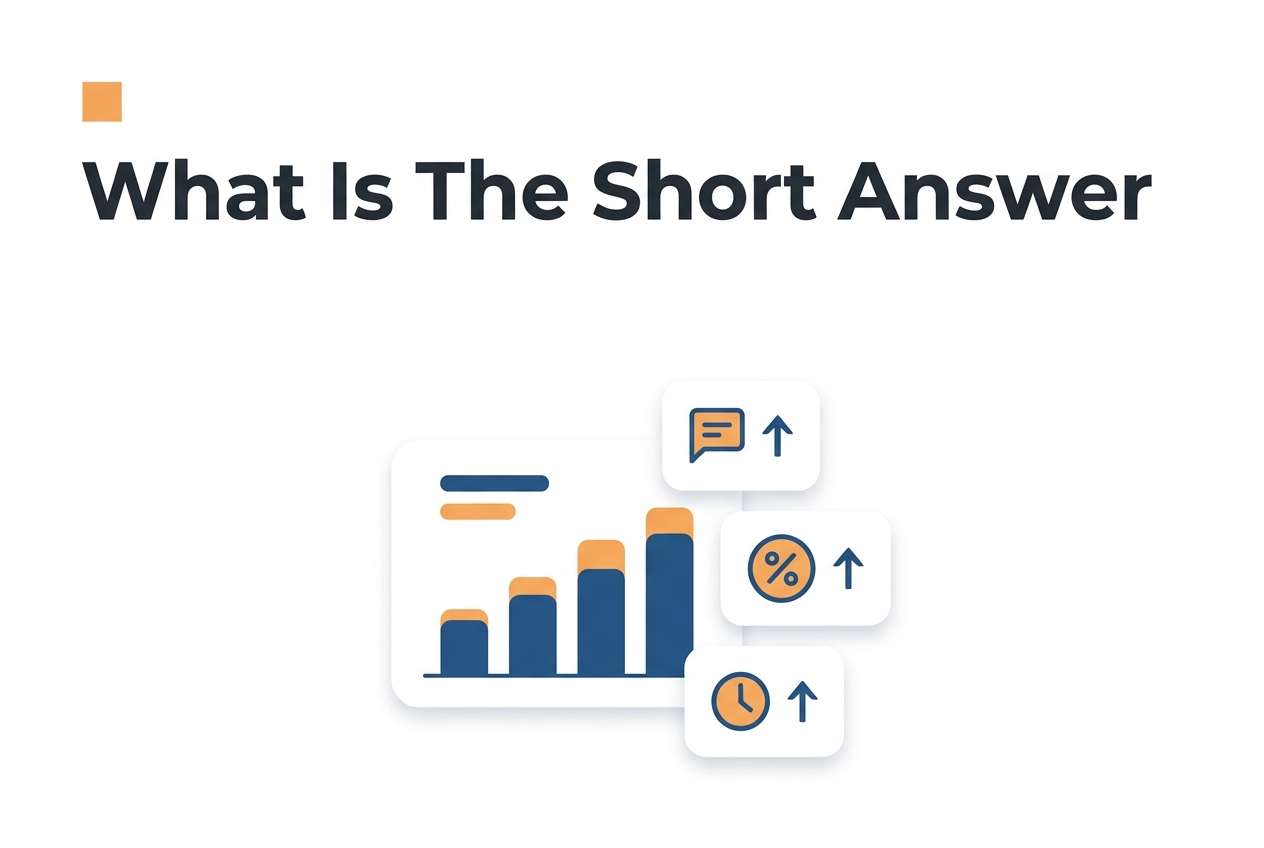
It’s simpler than you think: compare your monthly subscription cost against the documented lifts in inquiry volume, conversion rate, and time on site.
I see teams overthink this all the time. They want fancy multi touch attribution models when the actual math is dead simple. If you’re paying $29/month when billed yearly and the widget generates even one additional sale, you’re probably already in the black.
The real work? Establishing your baseline metrics before launch so you’ve got clean numbers to compare against.
Teams that aim to build trust on website should still measure the outcome. Video can help explain an offer, but it can also make no measurable difference. Traffic quality, message and placement are variables to test, not explanations for a guaranteed increase.
The metrics you should track aren’t complicated. Count form submissions, calendar bookings, or chat starts that follow a widget interaction.
Look at time on site for visitors who actually engage with the video versus those who skip past it. Track how conversion rates shift between periods with the widget active and paused. Most analytics setups can handle this with basic event tracking.
One thing that catches new installs off guard: the widget load time itself can mess with your data. If the video bubble adds too much weight to your page, you might see engagement go up but speed take a hit.
Check Google Web Vitals guidance and run a page speed test before and after installation.
A slower page can absolutely cancel out whatever conversion gains you’re getting from better trust signals.
Why does this matter?
Because if you’re not measuring, you’re just paying for expensive decoration. And honestly? Most teams never close the loop between installing a video widget and figuring out whether it’s actually making them money.
Your visitors arrive with intent. They’ve got questions about shipping, fit, or whether your service actually covers their area. A video greeting catches that moment of curiosity and turns it into a real conversation. When you build trust on website through actual human presence, you shift people from browsing mode to buying mode.
But intent without tracking just evaporates.
I’ve seen teams discover six months later that their widget loads on every page but converts on none. The video file is too large, the call to action is buried below the fold, or the mobile placement is literally blocking the checkout button.
All fixable problems. But without metrics, you never even know they exist.
Keep the reporting period, visitor counts, completed actions and comparison method with every result. The available customer examples do not establish a reliable before-and-after uplift for ROI calculations.
Buyer intent is perishable. You’ve got maybe ten seconds to answer the unspoken question: “Is this business legit, and will they respond if I reach out?” Video widgets buy you that window, but only if you know they’re working.
Key article metrics are summarized in a compact visual card for quick scanning.
What to measure
See the static HTML data above for the full breakdown.
What should you do next?
Before you touch anything, screenshot your current conversion rate, average time on site, and monthly inquiry count.
Those three numbers are your reference point. Without them, you’ll end up chasing vanity metrics that don’t correlate with revenue. Most teams skip this step because it feels like busywork, but it’s the only way to know whether your video widget is actually earning its keep or just sitting there looking pretty.
Once you’ve got your baseline, build trust on website by placing a video greeting on your highest traffic landing page and running a 30 day test. Don’t test on multiple pages at once. Traffic attribution gets muddy fast when you do that. Pick one page, one audience segment, and one clear call to action.
Check your numbers at day 14 and day 30.
Judge the test against the additional profit needed to cover recording, subscription and staff costs. If the result is uncertain, investigate placement, message or the next step without assuming a fixed percentage threshold defines success.
CompleteGreet counts only unique visitors toward your monthly quota, not every page load or repeat visit. That keeps the flat rate billing predictable even when you scale. This distinction matters a lot if you’ve got returning traffic or a longer sales cycle. Plenty of competing tools bill by total video impressions or minutes watched, which can blow up your costs without warning.
Check mobile and desktop separately. Test a thumbnail or opening frame with comparable visitors; the available evidence does not substantiate an observed mobile click increase from the example previously described here.
Record your results in a simple spreadsheet: date, change made, traffic source, and outcome. After three months you’ll have a playbook built for your specific audience instead of generic advice you found online. That playbook is worth more than any single widget feature.
Figuring out the return on investment for a video widget takes more than counting clicks. You need to connect what the tool costs to actual revenue changes and efficiency gains.
The following ROI method uses explicit assumptions. The available customer examples do not substantiate an aggregate before-and-after study of six Danish businesses.
Use your own completed-action counts and a comparable group to estimate additional business. The customer examples do not provide a reliable average uplift for a revenue forecast.
The ROI Formula
Here’s the formula you’ll use to calculate ROI for your video widget. It’s straightforward.
ROI equals Additional Revenue minus Tool Cost, divided by Tool Cost, multiplied by 100.
Additional revenue equals additional completed sales multiplied by average revenue per sale, provided order value is comparable. If you start from enquiries, include the measured lead-to-sale rate. Assess ROI using contribution to profit after the relevant costs, not revenue alone.
Worked Example
For a hypothetical example, 500 monthly visitors at a 2% enquiry rate produces ten enquiries. If 20% become customers and each sale contributes 1,000 DKK before video costs, that is two customers and 2,000 DKK in contribution. Enquiries are not automatically sales.
If the hypothetical enquiry rate rose from 2% to 2.4%, the same 500 visitors would produce twelve enquiries. With an unchanged 20% close rate and 1,000 DKK contribution per sale, the expected additional contribution would be 400 DKK per month. These are assumptions, not a measured or expected video result.
Subtract the actual recurring and allocated production costs from that additional contribution. If those costs were hypothetically 250 DKK per month, the net gain would be 150 DKK and ROI would be 60%: (400 minus 250) divided by 250. This is a worked example, not a current plan quote or a return forecast.
Give it at least 30 days of tracking before you calculate final ROI.
The math rarely lies when your inputs reflect actual visitor behavior.
Once you know your real inquiry volume and conversion rates, the formula takes the guesswork right out of budget decisions. Most businesses break even within the first month. After that, returns compound as the widget keeps collecting data and building trust with repeat visitors.
Common questions
How much does CompleteGreet cost per month for a small business website?
CompleteGreet starts at $29/month when billed yearly for 5,000 unique visitors, with no overage fees or per minute charges. You pay a flat rate based on visitor count, not video watch time. The BUILD plan at $29/month when billed yearly includes 2 video bubbles and basic analytics. Higher tiers go up to $489/month when billed yearly for 500,000 visitors. Annual billing saves you 20%.
How long does it take to set up CompleteGreet on a WordPress or Shopify site?
Most sites go live in under 5 minutes. You paste a single script into your site header, or use the Shopify app if that’s your platform. No developer needed. The widget loads after your page content, so it won’t slow down your site speed.
What website platforms does CompleteGreet support?
It works on Shopify, WordPress, Wix, Squarespace, Webflow, WooCommerce, and any custom HTML site. You get the same features across all platforms. The installation method changes slightly (Shopify uses the app store while others use a script embed), but the widget behaves identically once it’s live.
How does CompleteGreet billing work for video views and visitor traffic?
CompleteGreet counts unique visitors per month, not total video plays or watch minutes. One visitor can watch your greeting ten times and it still counts as one. That matters because competitors often bill by video minutes consumed, and costs balloon fast if visitors replay or watch longer videos.
What type of business should use CompleteGreet vs other video tools?
Service businesses, coaches, agencies, and ecommerce stores use it to put a real face in front of new visitors and build trust. That reduces bounce rates on cold traffic. If you’re running heavy survey workflows or complex chatbots, look elsewhere. CompleteGreet is built for greetings, not forms.
Does CompleteGreet offer a free trial to test before buying?
Yes. The 30 day free trial includes 5,000 unique visitors and one video bubble. No credit card required. You can test the full feature set, including analytics and URL targeting, before paying anything. After the trial, the BUILD plan at $29/month when billed yearly is the entry point.