
 Profile
 Dashboard
 Logout
Table of contents
Key takeaways
- A real recording shows the person behind the business. Whether that changes trust or conversion needs to be tested rather than inferred from unverified customer figures.
- Visitors look for proof that a business exists, responds, and has satisfied other humans before them.
- Most teams spend more time debating whether to use video than actually setting it up.
What does the data show about faces convert better than text?
A face and voice can introduce a service provider, but the available customer examples do not substantiate an average enquiry increase.
The effect isn’t limited to form fills.
Track completed enquiries, bookings and purchases separately from session duration. The available examples do not establish a consistent increase in any of those measures.
A face can help identify the person behind a business. To build trust on your website, provide accurate contact and service information too. The available examples do not establish that recognition causes more enquiries.
Different audiences may respond differently. There is no verified average uplift across industries in the available evidence.
What makes visitors trust a website they have never seen before?
Visitors look for proof that a business exists, responds, and has satisfied other humans before them.

The first scan happens in under three seconds. They check for a phone number, a physical address, and recent activity. A site that hides its contact details behind a generic form raises immediate suspicion. So does a blog with no posts newer than 2021.
Security badges matter less than most designers think. The padlock icon in the browser bar is expected now, not impressive. What actually moves the needle is social proof from people who look like the visitor. Testimonials with full names, photos, and specific outcomes outperform star ratings by a wide margin.
Video changes the equation entirely.
A team recording gives visitors a face and voice to associate with the business. Use clear audio and an accurate explanation. The available examples do not establish a neurological mechanism, an ideal production style or a predictable conversion benefit.
To build trust on website pages effectively, place the video where first time visitors land, not buried three clicks deep. The thumbnail should show the person looking toward the camera, not staring at a screen or reading from a script. Eye contact is the trust signal that text cannot replicate.
Try a short recording in a quiet, well-lit setting. This is a practical starting point, not a documented conversion experiment.
Avoid auto, play with sound. Nothing destroys trust faster than a loud voice surprising someone in a quiet office.
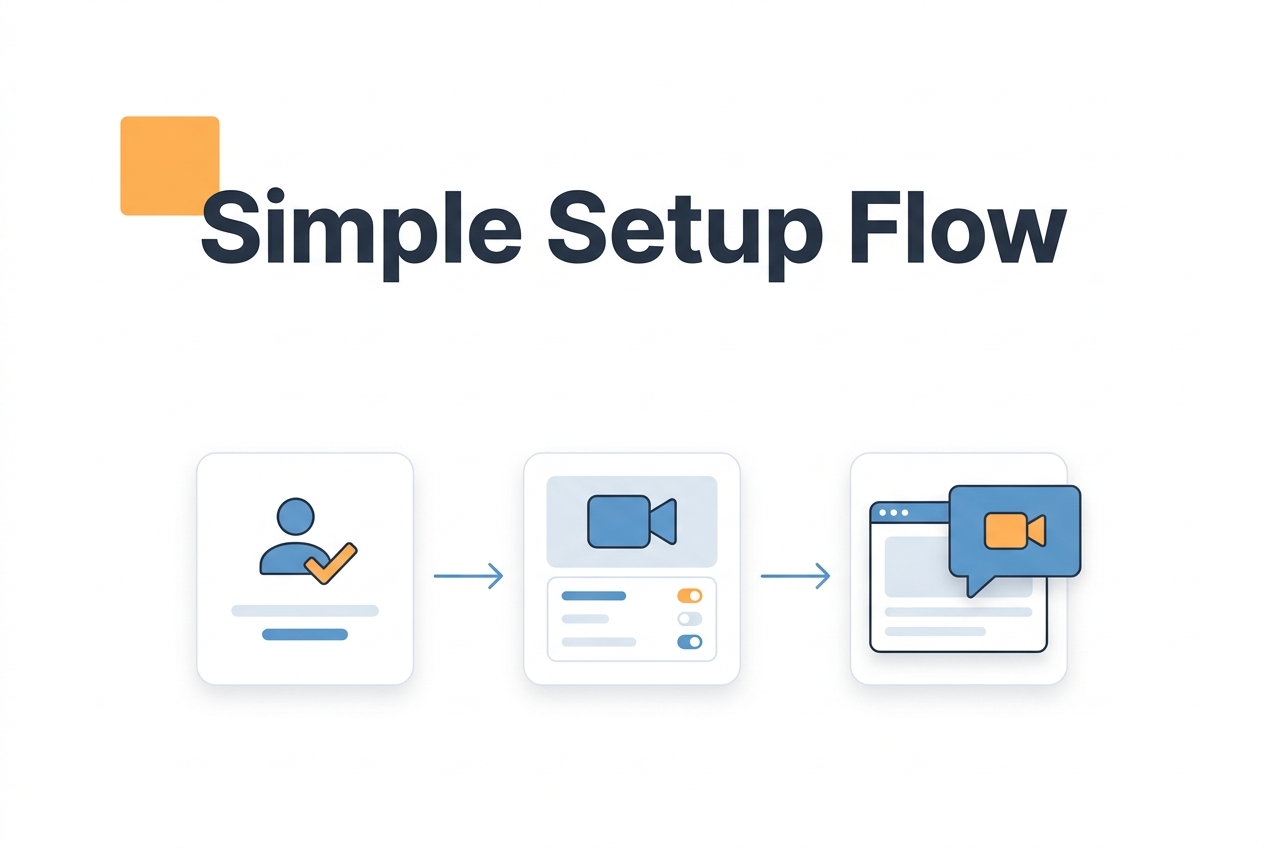
How to set up your first video greeting in under 5 minutes
Most teams spend more time debating whether to use video than actually setting it up. The process takes under five minutes once you stop overthinking the production quality.
What to say
You don’t need a teleprompter or a written monologue. Record a 15 second greeting that says who you are, what you help with, and what the visitor should do next. Keep it simple. Something like: “Hi, I’m Sarah from the support team. If you have questions about sizing, tap the button below and I’ll send you our fit guide.” The specific offer matters more than perfect lighting.
Where to place it
Placement determines whether anyone sees it.
If you want to build trust on your website, place the greeting where it answers a relevant question. Check spacing on mobile and desktop so it does not cover the main action. The available evidence does not establish a universally best placement.
Set your trigger to delay 3 seconds on desktop and 5 seconds on mobile. Immediate pop, ups annoy. Delayed ones catch visitors after they’ve scanned your headline.
How to measure results
Track completed enquiries per eligible visitor using a comparable control or baseline. Record session duration separately; the available examples do not provide a typical uplift.
Don’t obsess over play rates. A visitor who watches 10 seconds and then fills out your form converted. A visitor who watched the full 60 seconds and bounced did not.
Test your thumbnail frame carefully. The still image that shows before the visitor clicks matters more than the video quality. Pick a frame where you’re mid, sentence with visible energy, not the frozen smile at the end. Most platforms grab the first frame by default, which usually catches you adjusting your collar or looking away.
Upload your file, set the position, paste the one, line embed code, and publish. You can refine the script next week.
Human brains process facial expressions in approximately 170 milliseconds, creating an immediate trust signal that text can’t replicate through sequential reading. This neurological shortcut explains why video elements consistently outperform written copy in conversion environments.
The data below isolates the specific metrics that drive this trust advantage.
Neuroscience research confirms that facial recognition activates the amygdala and fusiform gyrus before conscious evaluation begins, establishing trust during the first fixation. Text requires linear processing through multiple cognitive stages, adding friction that extends the path to conversion.
Test the greeting against your current experience using the same audience and goal. The available evidence does not substantiate an engagement or enquiry advantage over a static header.
For a service page, count completed bookings as well as video interactions. The customer examples do not establish a booking increase or prove a transfer of trust from face to brand.
CompleteGreet handles the technical delivery of these assets through a global content network that maintains the sub, second loading speeds required for trust preservation. Video files larger than 2MB often negate the trust benefit by introducing perceptible latency, so compression and format selection remain important factors.
Test whether the greeting answers a question on the page and supports the intended action. Widget interactions alone do not establish a conversion lift against a static header.
The available evidence does not establish a 72-hour result or an automatic dashboard measure of causal uplift. Set up a baseline or comparable control and assess completed actions with visitor counts.
Common questions
Why do faces on websites convert better than text?
A face and voice provide information about a person that plain text does not. They do not guarantee trust or conversion. Test whether the recording answers visitors’ questions and helps them complete the intended action.
How much can video greetings increase inquiries and conversions?
There is no verified typical uplift in the customer examples reviewed here. Define the goal, count eligible visitors and completed actions, and compare equivalent groups before attributing a change to video.
What should you say in a 30 second video greeting?
State your name, role and the problem you help with, then offer a next step. A fictional example is: ‘I am Sarah. I help contractors with their books. If that sounds useful, use the calendar below.’ This is sample wording, not a documented customer result.
Where should you place a video greeting on your website?
Consider pages where visitors need an explanation before acting, such as pricing, services or complex products. Test the placement rather than assuming it has the strongest return.
Do video widgets slow down your website?
Loading behavior depends on the widget, video files and page configuration. Test your own setup with Google PageSpeed Insights before and after adding the video, and assess conversion separately. A performance benefit or an offsetting conversion gain is not guaranteed.
Which businesses benefit most from video greetings?
Video can introduce a service provider or explain a complex product. Its value depends on the visitor’s question and the business goal; the available examples do not establish which industries get the strongest returns.
How do you measure if your video greeting is actually working?
Track completed enquiries or purchases per eligible visitor on the affected page. Use a control group where possible, or account for traffic and seasonal differences in a before-and-after comparison. Thirty days alone does not establish statistical confidence.